Wednesday, March 16, 2011

New Places for Plants

Last year I was doing a research seminar at school, addressing the Urban Heat Island Effect with vegetation. As a student of Landscape architecture i was creating large strategies that wouldn't get build. Unhappy with this as an outcome I went about on a small scale trying to change peoples understanding of where plants can grow in an urban environment.


Armed with dog food tin's and old electrical goods stuffed with plants I hit Flanigan Lane in Melbourne. I chose this area, as it hasn't been re developed and due to its historical significance might remain as it is. Making this a good place to install and test ideas over the years. 

 
Some images sourced from Melbourne Art Critic

Welcome to Telstra

   "Welcome to Telstra mobile, Sorry I have just had to restart my computer, could you hold the line a minute". translation Sorry I'm in the middle of pok-ing, let me just finish this colour. In 2005 i was working in a call centre, saving to go see Anna who was studying in Milan. This being my first job at a desk, I took full opportunity to Pok like crazy. Other then these books, I worked on stickers that made there way up around our city. I'll have to find some photos off my old computer.


 You may notice a Chicken throughout. This is Chicken Heart (Anna Sassi). Reflecting on these books I would say this is where the MANIC MASK first appeared.

Tuesday, March 15, 2011

Pok Plants


    Starting of this year one of my main goals was to come out of this master with built works. For this reason I decided to revisit a design i had created in 2009 where I was merging street art with Landscape Arch. Although I wasn't going to be able to build a work of this size. I began working on smaller models, using the same concept.
I have created a simpler watering system for this model then above, whilst achieving a similar effect. Rainwater is caught on the roof or the rectangle and on the corrugated plastic. This water is then directed towards the back of the soil profile. Holes where then drilled into the corrugated plastic to allow some water to come through at the top.


 A zig zag system is also put in place, except this time I have used polystyrene strips to direct and catch water inside the soil profile.  Smaller polystyrene pieces are then place in between to reduce the amount of soil used,  responding to heavy weight of the garden.
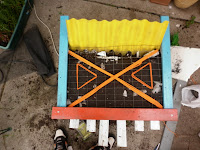
Fly wire then wire mesh is placed over the front of the box, then held in place by the surrounding frame.
I used nylon rope for some of the detailing of this garden, as it was colourful, and would last for a long time.


Although this is finished, i am going to let the plants settle for a week, before installing them on a wall.

Looking at the same work about three week's later I was surprised to see how well the cactus and succulents have established already. Not only have they looking happier, they have already began the process of phototropism, which is when a plant corrects its position in accordance to the sunlight.


I have finally got around to putting one of the Pok Planters into the street. What I have learned from this is that I need to make the Hanging gardens much lighter.


Learning from the two planters I had made earlier I have set about making a third. This one is slightly larger, but is half the weight. I have achieved this by firstly making it half as deep and secondly, putting more broken polystyrene to soil ratio. 


ANCIENT CULTURES TRIBAL AESTHETICS SYMBOLOGY AND LA POK


I was walking past this house thinking of ways to applying LA POK when I saw these two hedged conifers standing proud either side of the front door. I imagined them body Guards to the house and laughed. These guardians reminded me of Totem poles outside a North West Coast Indians building.


Referencing the way North West coast Indians decorated their homes and landscapes. I wish to investigate the roles these characters played in their mythology and culture. Is it possible to apply these principles to our own culture. I propose to do an installation in the front yard of a typical Melbourne suburban house and test these ideas.


Each clan has a mascot that is the animal that long ago allowed them to share the plentiful land which they lived. Other animals then feature in the totems and house detailing. They are not supposed to represent the animal but a mythical version of that animal.

The creators of these works tried to achieve as much variety and difference within the limitations and rules that where placed upon them by their cultural beliefs. Maintaining these guidelines was a way of paying respects to their ancestors. Despite these limitations the creators pushed against these rules to create individuality whilst staying within the respective guidelines.

Old Books

From the beginning of La Pok working in books has been a large part of my work. As i was on the move a lot between 2004 to 2007 I could just carry my brief case and book i was working on. I am reflecting on these books, so as to get a better understanding of my own approach.


 This book from the middle of 2004. It was about looking for things I was yet to see. Ink following through to the next page prompted the starting point for most images. This created a link from one page to the next. I was not really tying to do great stuff, instead I thought the more i do the more i can learn and progress.


This is a book that i had whilst in North America in 2005. 

Sunday, March 6, 2011

POSKA LANDSCAPES


La Pok has been a very important part of my life for the last 7 yrs. The name derived form books I was working on in 2003, when I first started to study Landscape Architecture. At this time I was working on what I called Posca Landscapes. This comprised of imagery that I would put out of context in collage and drawn over with mixed mediums, in particular Posca paint pens. From here when asked what I was doing I would reply “poking” and this is where La Pok derived from.


Saturday, March 5, 2011

LA POK ESCAPES - Intent and Precedents


The intention of my research is to explore ways in which I can express my visual interests as an artist and convey these idea into landscapes. I will begin by establishing my approaches, techniques, rules and guidelines associated with my work, then combining this knowledge with specific interest I have acquired throughout the duration of this course. Focusing on Urban heat Island Effect and Living environments, with the ambition to create fun spaces.

I believe we are witness to a time, experiencing many changes in regards to technology and life style. As a Landscape Architect I think about this time of change and question whether, these advances are translating into our field of design. There are some exceptional projects going on at the moment, but the majority of work is very stagnant and predictable. For these reasons I believe that it is beneficial to the discourse of Landscape Architecture that I conduct my research in La Pok Escapes.

The method of research that will be of most use to me, will be acquired through building and creating concepts. These ideas will be presented as installations in street scapes. These projects will firstly have an inte­ntion of what I wish to test, then an outcome that I will be able to document. For example the success of planting schemes, public interest or interaction. ­­­Through this process I will be able to build a body of research into my topic of LA Pok Escapes and how I can design spaces­ in the future.

The precedents below are of aesthetics within built or representation of built environments that have greatly influenced me as an artist and landscape architect. 


Houses of Ndebele people of Africa. The colour and decoration of their homes is essential to their culture and livelihood. This is comparatively the complete opposite to us, as we opt for monochromatic world.  


The second precedent is of Two projects completed in  Brazil,  by The Dutch artist duo Hass and Hahn. These projects are quite simple concepts, but are so effective and overwhelming due to their scale. Bringing life to heavily concreted areas in Favelas, with bright and exiting patterns and imagery.  


Keith Haring is also a major influence to me as an artist. His work is defined by a very distinct and refined visual language. A select range of motifs are continually repeated at different scales and in different context, that give his work a fresh appearances every time.


In the same way the Howard Akleys work questions certain Utopian and Aesthetic ideals in the urban environment, La Pok Escapes seeks to redefine our preconceived ideas of luxury and juxtapose current landscape and architectural aesthetics.